House clearance in Lucan: how big will the load be?

The size of a house clearance in Lucan is decided by how long the family has lived there, not by how hard the house is to get into. Most Lucan houses are estate semis with a driveway, a garage, a shed and a pull-down attic ladder, so the van sits at the door and the work is all volume. A garage, an attic and a shed together come to roughly a full van on our planner, before a single room of the house is counted.
This guide is for anyone in Esker, Hillcrest, Griffeen Valley, Foxborough, Finnstown, Adamstown or the old village who needs to know how much there is before they ask for a price. It explains how to count your own load, with real figures from our van load planner, and how to tell whether you are looking at one trip or two. For the local detail on access and the estates, see our house clearance in Lucan page.

Why Lucan jobs are about volume
Lucan has grown from a village on the Liffey into one of the largest suburbs in the county, and nearly all that growth is estate housing from the 1980s onward. Esker and Hillcrest date from the 1970s and 80s, Griffeen Valley, Foxborough and Finnstown from the 1990s and 2000s, and Adamstown is the planned new town that has been going up since the mid-2000s, with apartments and duplexes alongside houses.
In estates like these, driveways, side gates, pull-down attic ladders and integrated garages are the norm. The van is almost always on your driveway or directly outside, and a shed or garage empties through the side passage rather than the house. Access rarely slows a job, which means the main variable is how much stuff there is.
That makes sizing the load the most useful thing you can do before you ask for a quote. The rest of this guide is how to do it.
How the van load planner counts
Our van load planner gives every item a share of a full box van, where a full van is 100. It is a rough guide, not a quote, and it is built from a short list of common items.
| Furniture | Figure | Appliances and others | Figure |
|---|---|---|---|
| 3-seater sofa | 10 | Fridge-freezer | 4 |
| 2-seater sofa | 7 | Washing machine | 2 |
| Armchair | 4 | Cooker | 3 |
| Double bed with mattress | 8 | TV | 1 |
| Single bed with mattress | 5 | Bin bag or box | 0.5 each |
| Mattress only | 3 | Lawnmower | 2 |
| Wardrobe | 8 | Bike | 2 |
| Chest of drawers | 3 | Garden furniture set | 6 |
| Table and chairs | 7 | ||
| Desk | 3 | ||
| Bookcase | 3 |
The planner then turns the total into a band:
- Under 12: a small load, a few items.
- 12 to 37: about a quarter of a van, typical for one room or a shed.
- 38 to 62: about half a van, typical for a garage, an attic or a small flat.
- 63 to 87: about three-quarters of a van, typical for a 2-bed clear-out.
- 88 to 105: roughly a full van load, typical for a full house, or a big attic and shed together.
- Over 105: more than one van load, and we plan two loads or a bigger crew.
Something not on the list can be added in the message box, or sent as a photo.
The garage
In estates like Esker, Hillcrest and Foxborough the garage has often long since become a storeroom. The usual contents are bikes, tools, timber, boxes from the last move that were never opened, old garden furniture and sometimes a second fridge or freezer.
Here is a worked count. A garage with three bikes (6), a fridge-freezer (4), a washing machine (2), a lawnmower (2), a bookcase (3), a desk (3), a chest of drawers (3), 16 bags (8) and 14 boxes (7) comes to 38. That is the bottom of the planner’s half-van band.
How to count your own:
- Pull a rough list together standing in the doorway. Big items first.
- Count the shelves in boxes. A full shelving unit is often twenty to thirty boxes, and each is 0.5.
- Look behind and underneath. The back wall is where the second fridge-freezer lives.
- Photograph from the door with the light on.
Our garage clearance guide explains what typically turns up and what we cannot take, and the garage clearance page covers the service.
The attic
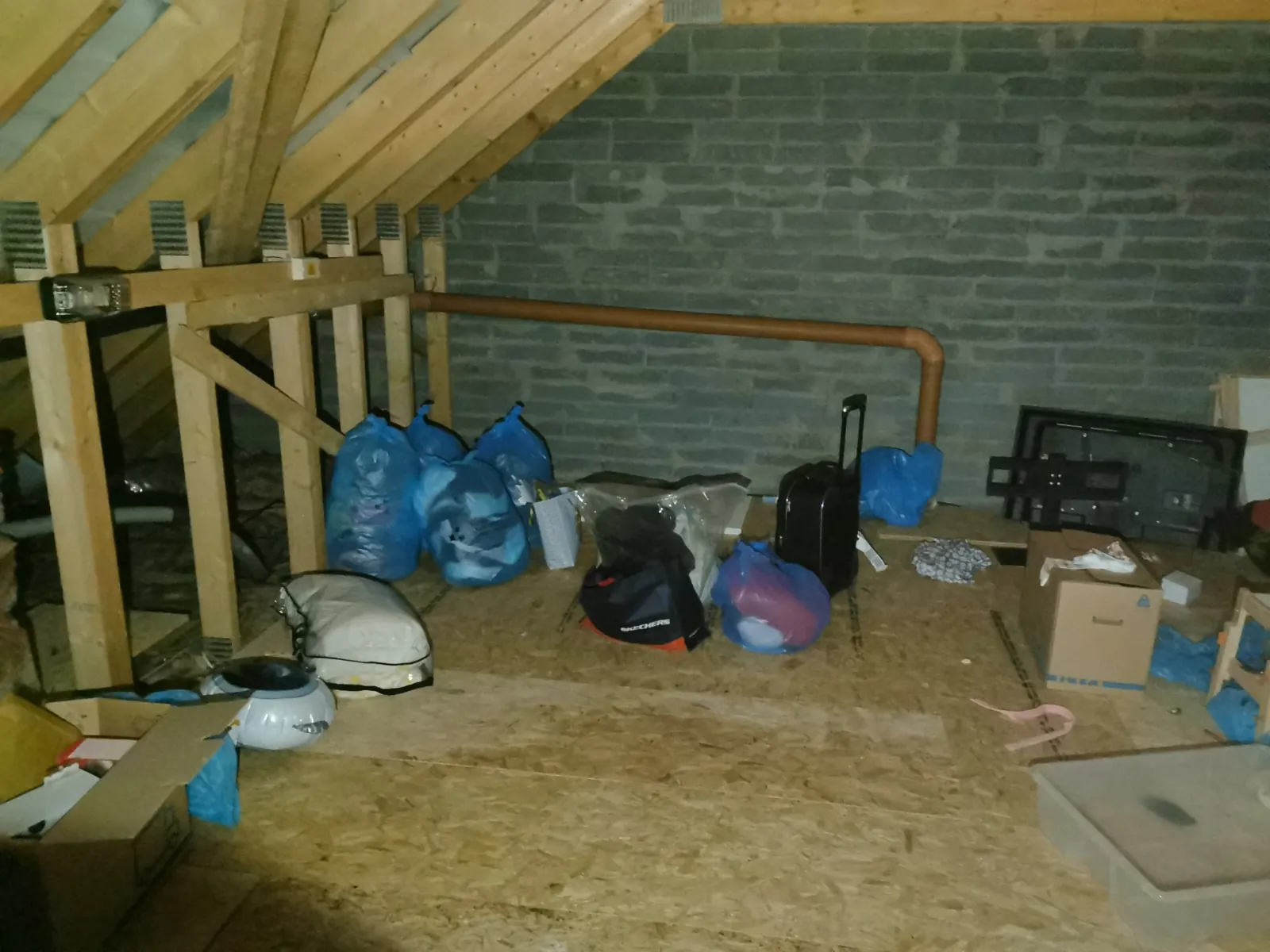
Attics in Lucan houses are quick to work because nearly every one has a pull-down ladder and a landing to stage boxes on. The load is light but takes space: boxes, bags, suitcases, children’s furniture and decorations.
A worked count: 30 boxes (15), 20 bags (10), a single bed with mattress (5), a chest of drawers (3) and a bookcase (3) comes to 36. That is just under the half-van band.
Counting tips:
- Count boxes by the stack. Four rows of five is twenty.
- Ask what is behind the water tank. It is where the oldest boxes are.
- Note any boards. If the attic is not boarded, say so, because it affects how the crew moves around.
- Tell us about the ladder. A sturdy pull-down ladder is fine; a loose or damaged one needs a conversation.
Our attic clearance guide covers how an attic is emptied safely.
The shed
A shed is often the smallest of the three loads, but it can hide surprises. A worked count: a garden furniture set (6), a lawnmower (2), two bikes (4), ten bags (5) and six boxes (3) comes to 20. That is in the planner’s quarter-van band.
Typical contents include hoses, tools, plant pots, timber offcuts, paint tins and the odd appliance. Paint and chemicals are not carried in quantity, so ask us before the day. Taking the shed itself down is a different and larger job, and our shed clearance page explains it.
Adding it all up
Put the three together. The garage is 38, the attic 36 and the shed 20, which is 94. That is the planner’s full-van band, and that is before any of the house has been counted.
Now count the rooms. A three-bed house typically adds beds, wardrobes, chests of drawers, a living room set, a kitchen table and a handful of appliances. A realistic three-bed semi with three wardrobes, three chests of drawers, two double beds and a single, a 3-seater and a 2-seater sofa, two armchairs, a table and chairs, a desk, two bookcases, a fridge-freezer, a washing machine, a cooker, two TVs, 20 bags and 30 boxes comes to 131 on its own. With the garage, attic and shed it is well over two van loads.
That does not mean it is an enormous job. It means a three-bed Lucan semi with all of its outbuildings in play is a day for two people with two loads, or a bigger crew, and we plan that when we quote.
When is it one trip, and when is it two?
A rule of thumb that works well with the planner:
| Planner total | What to expect |
|---|---|
| Under 38 | A short job; quarter of a van or less |
| 38 to 87 | Half to three-quarters of a van; a morning or a day |
| 88 to 105 | One full load, tightly packed |
| Over 105 | Two loads or a bigger crew |
If you are near 105, expect a second load, because boxes and bags never pack perfectly. We say in the quote whether we expect one load or two.
Larger houses in Finnstown and the Lucan Demesne roads
Finnstown and the roads towards Lucan Demesne also have a number of larger detached houses with double garages. Those are a full day’s work on their own. The planner has no figure for a double garage as such, so count the contents the same way, and tell us it is a double so we plan the space.
Adamstown and the older village
Adamstown has apartments and duplexes as well as houses, and the old village at the bottom of the hill has Georgian and Victorian houses and a handful of apartment blocks built in the last twenty years.
For apartments, the questions are about the building: the lift, the management company and the van height in underground car parks. Apartment blocks in Adamstown have lift access and underground parking, but van height can be an issue in the car park, so we usually load from the street or a visitor space. If the management company needs notice or a copy of our insurance, we can provide it. Our apartment clearance page covers this in more detail.
The older houses in the village are a different mix of stairs and parking, so tell us what the road is like when you send photos.
Counting the rooms of the house
Once the outbuildings are counted, take the house a room at a time. The figures below come straight from the planner, and the examples are the kind of contents a family house in an estate tends to hold.
A main bedroom. A double bed with mattress (8), a wardrobe (8), a chest of drawers (3) and two bags of clothes (1) comes to 20. If there are two wardrobes, add 8.
A single or box bedroom. A single bed with mattress (5), a wardrobe (8) and a desk (3) is 16. Add boxes of books and toys at 0.5 each.
A living room. A 3-seater sofa (10), two armchairs (8), a TV (1), a bookcase (3), a chest of drawers (3) and six bags (3) comes to 28. A table and chairs in the same room adds 7.
A kitchen and dining area. A table and chairs (7), a fridge-freezer (4), a washing machine (2), a cooker (3) and ten boxes of crockery and kitchenware (5) is 21.
A spare room used as a store. This is the hardest to judge. Count the furniture, then the boxes, then look at the floor: if you cannot see it, assume the room is a quarter of a van.
Add the rooms, then the garage, attic and shed. Do the sum twice, once cautiously and once generously, and send us both numbers. A range of 85 to 110 tells us more than a single guess.
What people forget to count
The same things tend to get left off the list:
- The second fridge-freezer or chest freezer in the garage or utility room.
- Mattresses and bed bases in rooms that are no longer used.
- Curtains, rugs and carpets, which are bulky even though they feel light.
- Garden furniture covers and cushions, which fill bags quickly.
- Loft insulation, boards and offcuts left from old building work.
- Suitcases, which are bulky and often full.
- The wheelie bins: ask before the day whether anything inside them is going.
None of these are big individually. Together they can move a three-quarter load into a full one.
Splitting the job into two visits
Sometimes it makes sense to do a Lucan house in two visits rather than one. It works well in two situations.
The family wants to sort in stages. The first visit takes the garage, shed and attic, which nobody needs to decide on, and the second takes the house once the family has been through it. This gives the family time without holding up the whole job.
The date is fixed but the decisions are not. Clear the outbuildings now to create space and see what is left in the house.
A second visit costs more than doing the job in one, because the crew and van travel twice, so it is worth doing only when there is a real reason. Tell us what you are thinking and we will say honestly which is better.
Getting the driveway ready
Because the van is usually on the driveway in Lucan, a little preparation helps:
- Move cars off the drive the evening before, or tell us which space to use.
- Clear the side passage of bins and anything stored there.
- Open the garage door fully and check it works, since an electric door can fail without power.
- Unlock the side gate and leave the key with whoever is holding the house keys.
- Mark any plants or garden items you want to keep that sit near the path.
What changes the quote
We quote a fixed price from photos. We do not publish prices, but we can tell you what moves them:
- The load size, as counted above.
- What the load is made of. Mattresses, carpets and soft furnishings cost more to dispose of than timber furniture.
- Access. Lucan is usually easy, but tight cul-de-sacs or shared surfaces in Adamstown and Griffeen Valley may mean parking at the entrance and carrying further.
- Stairs and attics. A ladder is quick; a hatch with no ladder is not.
- Anything unusual. Piano, safe, range cooker or any fixed item.
If a load turns out bigger than expected, send extra photos as soon as you find more and we update the quote before the day.
Photos that make the count accurate
- The front of the house and the driveway, so we can see where the van goes.
- Each room from the doorway.
- The garage from the door, with the light on and the door fully open.
- The shed, inside and out.
- The attic hatch and ladder, and a photo up inside if you can.
- The side passage and gate, because everything outside comes through it.
- Anything big or heavy.
Send them with the Eircode to 085 202 1222 on WhatsApp, or use the quote form. Our planner on the home page can also send your list straight into the form.
Selling or letting: the timeline
Most Lucan clearances are tied to a date, and the order of work depends on it.
Selling. Clear before the viewings if you can, because an empty house shows better, but check with your estate agent first. Agree with the solicitor what stays: fitted units, light fittings and sometimes curtains. Leave the heating off but the electricity on.
Letting. Clear between tenants and mark what the next tenant gets, such as a bed or white goods. Photograph the property after.
Probate or inheritance. Check with the solicitor that the contents can be cleared before anything leaves the house. If you are at the stage of sorting a parent’s house, our guide to clearing a house after a bereavement covers the first visit.
Selling things first, and what to do with the rest
Before the clearance, it is worth asking whether anything is worth more to someone else than to the transfer station. Good solid furniture, bikes in working order, a lawnmower that still starts and a garden furniture set can all sell on online marketplaces or go to a charity shop. Selling takes time and the buyers have to collect, so start early and set a cut-off date, after which whatever has not gone is added to the clearance list.
Some practical rules for the selling stage:
- Set a date after which unsold items go on the list, and tell buyers.
- Do not leave valuables out for collection when nobody is home.
- Keep it simple. Selling a sofa for a small sum is rarely worth three missed collections.
- Remove sold items from the planner count, so the load is not overestimated.
Items that nobody wants are not wasted. Usable pieces we collect are set aside for reuse, donation or resale where possible, and we recycle, donate or reuse as much as we can.
How the two-load day usually runs
A Lucan house that comes to more than one van load is planned as two loads in one day, or a bigger crew. The working pattern is the same as for any clearance. The crew arrives at the agreed time and walks the house with whoever holds the keys. The outbuildings and attic tend to go first, then the house, so the driveway and hall stay clear for the heavy pieces. When the van is full, the first load goes to be sorted and disposed of, and the van returns for the rest.
Because a second load means the van leaves and comes back, it helps to keep the driveway clear and the house open in between. If you are not there, tell the key holder that the crew will be going in and out, and leave a contact number for them.
Planning around other jobs
In an estate house, the clearance is rarely the only thing happening. A solicitor, an estate agent, a buyer or a painter may be waiting on the house being empty. A few tips:
- Fix the clearance date first and let the others plan around it.
- Allow a day between the clearance and any works. There is always a last item or a last question.
- Tell trades the house will be empty, so they know there is nothing to protect or move.
- Keep a copy of the quote and the date for the agent or solicitor.
Where the load goes
Furniture and household goods that still have a life in them are set aside for reuse or donation. Metal, cardboard and timber are separated for recycling, electricals go through the WEEE scheme, and the rest goes to a licensed waste transfer station under our waste collection permit, NWCPO-25-13287-01. Our guide to what happens to items after a house clearance follows a load from the door to its destination.
Frequently asked questions
Can the van get into a cul-de-sac in Griffeen Valley or Adamstown?
Usually, but a few of the tighter cul-de-sacs and shared surfaces may mean we park at the entrance and walk further. Tell us the road when you ask for a quote and we will know.
Is a garage on its own too small a job?
No. A garage with bikes, a fridge-freezer and a few dozen bags and boxes is half a van on the planner, a normal job. Add the shed or attic and it costs less than booking twice.
How do I count a garage full of shelving?
Count the large items on the floor, then estimate the shelves in boxes. Each box is 0.5 on the planner. Photos from the door let us correct your count.
My attic ladder is loose. Can you still empty it?
Tell us before the day. A loose or damaged ladder is a safety issue, and we will say what is possible. Do not climb it with a heavy load yourself.
What if I have a double garage in Finnstown?
Count the contents as normal and tell us it is a double. A larger garage is a full day’s work on its own, and we plan the space accordingly.
Do you take the shed down as well?
Taking down the shed is a different and bigger job than emptying it. Send a photo of the shed and say which you want, and we will quote accordingly.
Can you clear a rental apartment in Adamstown between tenants?
Yes. Lifts, car parks and management companies are all part of the job, and we ask the right questions when quoting. Tell us the block and the management company contact.
How soon can you come?
It depends on the diary. Tell us your date when you send photos and we will say what we can do. We work Monday to Saturday.
What if the planner says more than one load?
Then we plan two loads or a bigger crew and say so in the quote.
Do I need to be there?
Not for the whole job. We need someone at the start and the end, but that can be a neighbour, a relative or an agent.
Should I move my car before the crew arrives?
Yes, if it is on the driveway. Move it the evening before, or tell us which space to use, so the van can sit as close to the door as possible.
What customers say
These are reviews from real customers, quoted exactly as they were written.
Ciprian and his team of two swiftly assessed the clearance based on provided photos, arrived punctually, and energetically tackled the task at hand. Despite my underestimation of the amount of junk to be cleared, they maintained the agreed price without any adjustments from their end. Their demeanor was friendly and their work highly efficient.
Anthony, City West
Would highly recommend Ciprian! Himself & his colleague did an excellent job on a house clearance recently. They were extremely thorough, professional & efficient. They arrived promptly & there was good communication with Ciprian who was easy to contact. A job well done.
Sinead Galligan
Next step
Send photos to 085 202 1222 on WhatsApp, or request a free quote online. Our house clearance page explains the service, the garage clearance page covers garage loads, and the attic clearance page covers lofts.