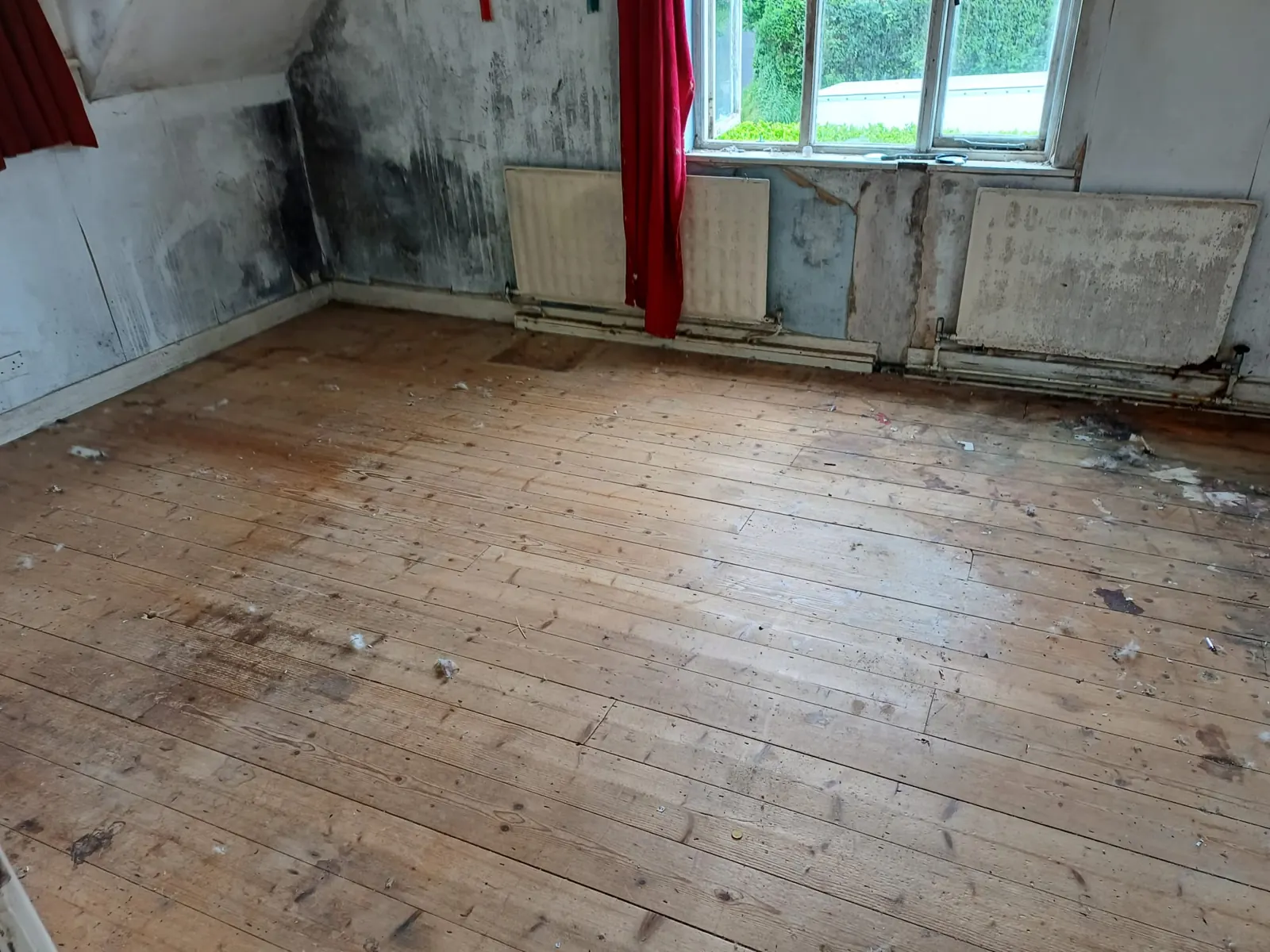
House clearance in Crumlin: sorting and loading a long-lived terrace

House clearance in Crumlin usually means a terrace that has been lived in for a long time and has never been cleared, so the job is mostly sorting and carrying rather than anything technical. Work through it in a set order: decide what stays, empty the box room and attic first, bring furniture down the stairs in pieces, and leave the shed and long back garden until last. The worked example later in this guide, a two-bed terrace with a garden full of shed contents, comes to roughly a full van on our planner.
Crumlin was laid out by Dublin Corporation in the 1930s and 1940s, and many of the houses are still with the families who first moved in. This guide is about how to approach one of those houses from the first walk-round to the handover of the keys. If you want the access and parking side, our house clearance in Crumlin page covers it. This guide is about the work itself: the order, the sorting, the loading and the size of the load.

What kind of house are we talking about?
The housing stock in Crumlin is remarkably consistent. Most of it is two- and three-bed terraces with a small front garden, a side passage on the end houses and a back garden longer than you would expect. The roads around Crumlin Village, Sundrive Road, Kildare Road, Clogher Road and Captain’s Road are largely this type.
That consistency helps, because it means you can predict where the work will be. The hall is narrow, the stairs turn sharply at the top, the box room over the hall is usually the fullest room in the house, and the attic hatch above the landing may not have been opened for years. Behind the house, the shed or lean-to is a long carry from the front door unless there is a side passage.
These houses were built for families who stayed. Many are only now being cleared for the first time, either after a parent has died or because a new generation has bought in and is renovating from top to bottom. In both cases the result is a full house, a full shed and often a full attic coming out in a single go. That is the job this guide is written for.
Step one: make decisions before you lift anything
The biggest time-saver in any clearance is deciding, room by room, what is going and what is staying. Walk the house with a notebook and write one of two things against each room: “everything goes”, or a keep list.
Most rooms in a full clearance are the first kind. The rooms that need attention are the mixed ones, and the usual culprits are the main bedroom (jewellery, papers, clothes someone wants to keep), the front room (ornaments, framed pictures, the good china) and the box room (anything and everything).
If you are working on a parent’s house, make the first visit a visit for looking and deciding, and the second the clearance itself. Trying to do both on the same morning is how keepsakes end up in a van. Our guide to clearing a house after a bereavement covers that first visit in more detail, including how to share out items fairly between family members.
A few ways to make the keep list work in practice:
- Move rather than label. Take everything you are keeping into one room and close the door. “Nothing leaves the back bedroom” is a far easier instruction for a crew than “the green chair stays but the other one goes”.
- Use tape and a marker for the odd item that has to stay where it is, such as a piece of furniture promised to a cousin that cannot be moved yet.
- Photograph the keep room before the crew arrives, so there is no argument afterwards about what was in it.
- Agree between family members before the day, not on it. Phone calls on the day cost time, and mistakes cost more.
Step two: find the things that matter
Before any room is signed off as “everything goes”, take out the items that cannot be replaced or that carry legal or financial weight. In houses that have not been cleared for a long time, these are rarely where you expect them.
Documents. Wills, deeds, bank and building society books, pension papers, insurance policies, passports, birth, marriage and death certificates, tax and medical records. Look in the sideboard, the bureau, the wardrobe, under the bed, inside books and in handbags.
Cash and valuables. Jewellery, watches, coins, savings certificates and cash. Common hiding places include biscuit tins, the pockets of coats at the back of the wardrobe, inside shoes, behind drawers, in the hot press and under the lining paper of drawers.
Keys. House, shed, garage, car and meter-box keys. A key you do not recognise often belongs to a cash box, a cabinet or a safe elsewhere in the house.
Photographs and letters. They turn up in the strangest places, including the bottom of wardrobes, inside suitcases in the attic and between the pages of old books. If there are a lot of them, box them up and take them home rather than sorting them on the day.
Medication. Take prescription medication to a pharmacy for disposal. It should not go into a black bag.
Electronics with data. Phones, laptops, tablets, hard drives and old camcorders. Keep them or wipe them.
Locked boxes and safes. Open them yourself, or get a locksmith in, rather than letting a locked box leave the house unchecked.
A good rule is to go through every drawer, every pocket and every book on the shelf of anything you are not sure about. It is slow, but it is far cheaper than a lost document.
Step three: tell the people who need to know
A clearance affects more people than the family. A few phone calls in advance prevent most of the problems we hear about.
- The solicitor or executor, if the house belongs to an estate. Confirm that the contents can be cleared before anything leaves the house. If a will or a grant is still being sorted out, wait.
- The home insurer. Many policies have conditions about a house left unoccupied for more than a set period, such as inspections or the water being turned off. Ring them and tell them the dates.
- The neighbours. Crumlin roads have cars on both kerbs, and a van with hazards on for several hours is noticeable. A word the day before is appreciated, and a neighbour is often the best person to hold the keys.
- The utilities. Do not have the electricity cut off before the clearance, because the crew needs light in the attic and under the stairs. Photograph the meter readings on the day.
- Any landlord, estate agent or buyer, if the house is being sold or let, to check what has to stay. Fitted kitchens, light fittings and sometimes curtains or a cooker may be part of the sale.
A four-week timeline
If you have the time, spreading the work out makes it much less stressful. The following is a general timeline rather than a rule, and it can be squeezed into a week if it has to be.
Four weeks before. First visit for looking and deciding. Find the documents and valuables, make the keep list, and tell the solicitor, insurer and family what you are planning. Start photographing the rooms.
Three weeks before. Share out the keep items between family members, and arrange for them to be collected or moved. Get a locksmith if there are locked boxes. Take medication to a pharmacy.
Two weeks before. Send photos to us on WhatsApp for a quote: each room, the box room, the attic hatch, the shed, the front of the house and the side passage if there is one. Agree a date.
One week before. Check the hiding places again. Move keep items into the keep room, shut the door and put a note on it. Tell the neighbours and arrange who will hold the keys.
The day before. Move your own car off the road in front of the house if you can, so the van has a space. Leave the electricity on. Make sure the crew can reach the attic hatch.
The day. Walk the house with the crew, confirm the keep room, hand over the keys. Photograph the meters. Leave the rest to us.
After. Collect the keys, do a last walk-through and decide whether the house needs cleaning before sale. A sweep is not a clean, so if it does, a cleaning company can follow.
The order to work through the rooms
A sensible order is the one that keeps the stairs and the hall clear for as long as possible, because they are the bottleneck in every Corporation-era terrace.
- Box room and attic first. They are usually the fullest, and the boxes and bags can be passed down while the landing is still empty.
- Bedrooms next. Beds and wardrobes come apart upstairs and go down in pieces. Mattresses are carried down whole and stood on their edge against the van wall.
- Front room and kitchen. Sofas, sideboards, the table and chairs, and the appliances. Fridge-freezers should be emptied and, ideally, defrosted the day before.
- Hall and stairs last, so nobody is stepping around furniture while carrying.
- Shed and back garden at the end, or at the start if there is a side passage on an end-of-terrace house and it is easier to load from there.
A mid-terrace house is different, because everything has to come through the hall. In that case some crews do the garden first, while the hall is still empty, and finish with the heavy furniture. We decide on the day once we have seen the house.
How things are sorted as they come out
Nothing has to be sorted before we arrive. But the sorting still happens, and it helps to understand the groups, because they decide what happens to your things afterwards.
| What comes out | What usually happens to it |
|---|---|
| Furniture in good condition | Set aside for reuse, donation or resale where possible |
| Worn or broken furniture | Licensed waste transfer station |
| Fridges, freezers, washing machines, cookers and electricals | Separated for WEEE recycling |
| Mattresses, carpets, underlay and soft furnishings | Licensed waste transfer station |
| Books and clothes in good condition | Donation where possible |
| Scrap metal, cardboard and timber | Separated for recycling |
| General household waste in bags | Licensed waste transfer station |
We recycle, donate or reuse as much as we can, and everything else goes to a licensed facility under our waste collection permit, NWCPO-25-13287-01. The sorting happens at the van rather than in your hall, so that a good armchair is never buried under a bag of rubbish. Our guide to what happens to items after a house clearance follows a van load from the front door to its destination.
Getting furniture down the stairs
The stairs are where most of the time goes in a Crumlin clearance. They are narrow, they usually turn at the top, and the hall at the bottom is not wide either. A few practical points:
- Wardrobes that will not make the turn are taken apart on the landing. Double wardrobes usually come apart into panels, doors and a top, which can be carried down one by one.
- Beds are dismantled upstairs. Slatted bases lift out, headboards unbolt, and divan bases are stood on their edge.
- Chests of drawers are emptied and the drawers carried separately. A chest with the drawers in is much heavier and more awkward than it looks.
- Mattresses go down whole, on their edge. They are bulky rather than heavy.
- Tables lose their legs where they unscrew, and glass or marble tops are carried flat by two people.
- Fitted wardrobes and units are a different job. Built-in furniture is a strip-out rather than a clearance, so send a photo and ask.
If a piece is too large to move at all, such as a very old wardrobe that was built in the room, tell us beforehand and we will say honestly what is possible.
How big is the load?
Our van load planner gives every item a share of a full box van, where a full van is 100. These are the figures it uses.
| Item | Planner figure |
|---|---|
| 3-seater sofa | 10 |
| 2-seater sofa | 7 |
| Armchair | 4 |
| Double bed with mattress | 8 |
| Single bed with mattress | 5 |
| Mattress only | 3 |
| Wardrobe | 8 |
| Chest of drawers | 3 |
| Table and chairs | 7 |
| Desk | 3 |
| Bookcase | 3 |
| Fridge-freezer | 4 |
| Washing machine | 2 |
| Cooker | 3 |
| TV | 1 |
| Bin bag or box | 0.5 each |
| Lawnmower | 2 |
| Bike | 2 |
| Garden furniture set | 6 |
Add up your list and the planner places it in a band. Under 12 is a small load. From 12 up it is about a quarter of a van, from 38 about half, from 63 about three-quarters, and from 88 to 105 roughly a full van. Over 105 it says more than one load.
A two-bed terrace with a double bed, a single bed, two wardrobes, two chests of drawers, a 3-seater sofa, an armchair, a table and chairs, a fridge-freezer, a washing machine, a cooker, a TV, 15 bags and 20 boxes comes to 83.5. That is the planner’s three-quarters band.
Now add the back garden: a garden furniture set (6), a lawnmower (2), two bikes (4) and six bags of garden rubbish (3). That brings the total to 98.5, which the planner calls roughly a full van load. A house with a full attic on top would pass 105, and we would plan two loads or a bigger crew.
This is a rough guide only. We always confirm the price from photos, because things like stairs, a heavy piano or a load made mostly of mattresses change it. You can try the planner yourself on our home page, where your list can be sent straight to the quote form.
The shed and the back garden
Back gardens in these houses are long, so a shed or lean-to is often a good carry from the house. On an end-of-terrace house with a side passage, the passage is the quickest route out. On a mid-terrace house, everything comes through the hall, which is why the garden is sometimes done first.
Typical contents are bikes, a lawnmower, garden furniture, tools, plant pots, hose, timber offcuts and the odd second appliance. All of that goes. Paint, chemicals, gas bottles and anything that might contain asbestos do not, so ask us before the day. A tin or two of paint is worth a question, while twenty tins is not a clearance item.
Soil, rubble and large amounts of hedge cuttings or old fencing are a different load. They fill a van quickly for what they weigh, and are often better with a skip. A few bags alongside a house clearance are fine. Our guide to house clearance versus skip hire explains when each makes sense.
Our shed clearance page covers taking the contents out, or taking the shed itself down, as a job on its own.
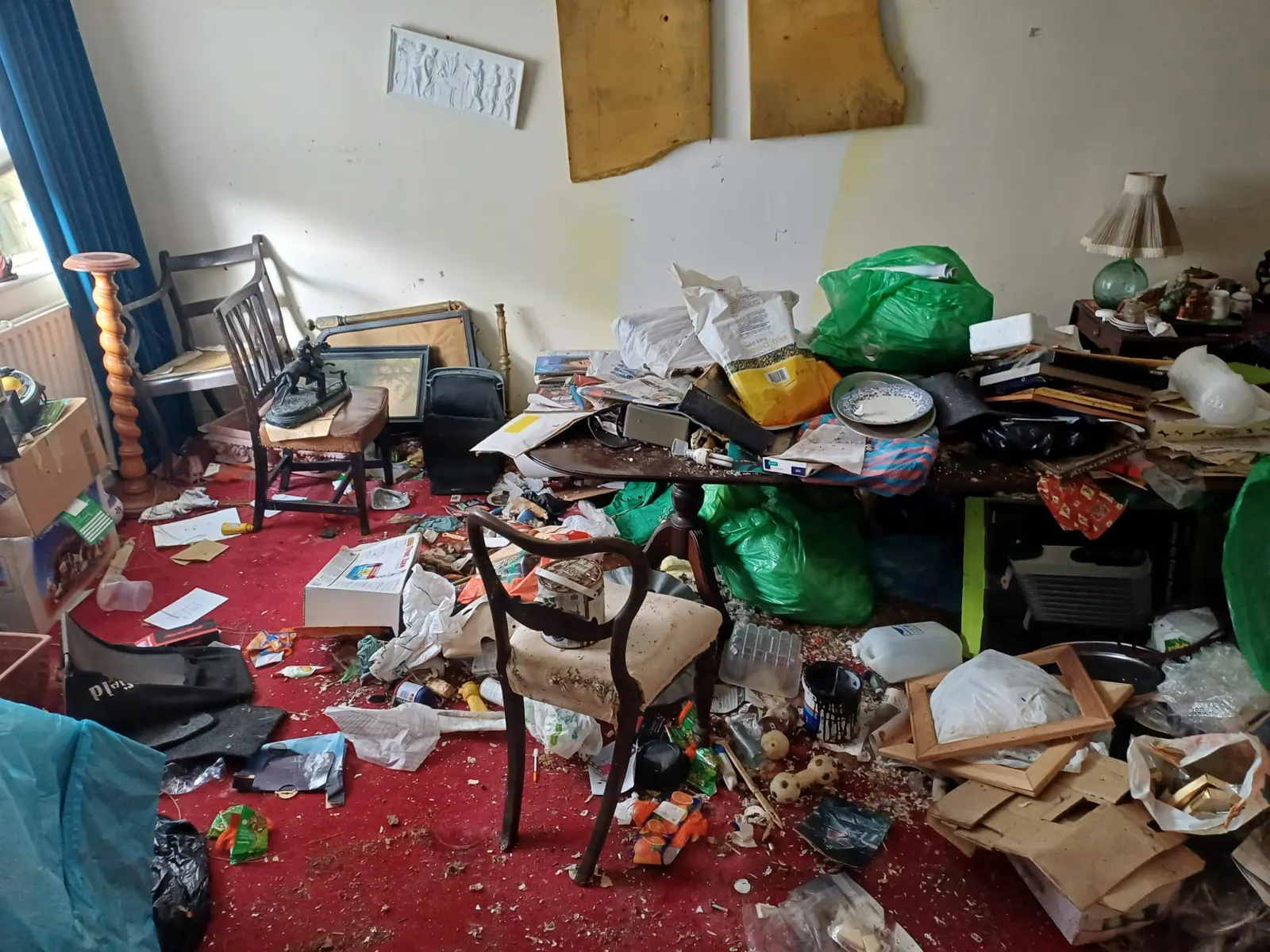
What you should photograph for a quote
A few good photos tell us far more than a description, and they are how we price a job without a visit. Aim for these:
- The front of the house, showing the door, the kerb, the parking and any steps.
- Each room, from the doorway, so the whole room is in the frame.
- The box room, with the door fully open.
- The attic hatch and, if you can, a photo up inside it.
- The stairs and landing, so we can judge the turn.
- The shed or lean-to, inside and out.
- The side passage, if the house has one.
- Anything unusually large or heavy: a piano, a range cooker, a sideboard or wardrobe that will not come apart.
Add a line with the Eircode, whether anything is staying and any dates that matter, such as a closing date. Send it all to 085 202 1222 on WhatsApp, or use the quote form.
What affects the quote
We quote a fixed price from your photos. We do not publish prices, but the things that move the number are straightforward.
- The size of the load, as above.
- Access: stairs, the turn at the top, a side passage or none, and the distance from the van to the door.
- Parking: whether the van can sit close to the house.
- What the load is made of. Mattresses, carpets and soft furnishings cost more to dispose of than timber furniture, so a house full of the former costs more than the same van load of the latter.
- Anything that needs separate handling, such as an item that has to be dismantled.
Send extra photos as soon as you find more. The quote is only as good as the photos behind it, and updating it before the day is easy.
What happens on the day
The crew arrives at the agreed time and walks the house with you, or with whoever holds the keys. This takes a few minutes and is the moment to point out the keep room and anything you have had second thoughts about.
Then the work goes room by room, starting at the top of the house. Items come down the stairs, are sorted at the van into reuse, recycling and waste, and are loaded. A two-person crew carries everything by hand. When the van is full, the load goes to be sorted and disposed of, and a second load follows if the house needs one.
You can stay or leave. Many families hand over keys and come back when it is done, and where the family lives elsewhere we can send photos as rooms empty. At the end, the crew sweeps the cleared rooms, checks every cupboard and the attic hatch, and hands back the keys.
After the crew has gone
A few things are worth doing once the house is empty:
- Take the meter readings if you have not already.
- Walk every room and the attic once more.
- Check the keys, including shed and meter-box keys, and label them.
- Decide about cleaning. We sweep but we do not clean. If the house is being sold or let and needs it, book a cleaning company for after we finish.
- Pass the keys on to the agent, solicitor or buyer.
Mistakes that cost time
- Sorting under pressure. Sorting paperwork on the morning of the clearance is where documents get lost. Box it and take it home.
- Forgetting the attic. In a Crumlin terrace the attic is easy to overlook, and it can be a quarter of a van on its own.
- Not telling the crew about the stairs. A wardrobe nobody mentioned that will not come down whole adds time.
- Leaving keep items scattered. A keep room with a closed door works. Items left around the house do not.
- Underestimating the shed. It is often fuller than it looks from the garden.
Frequently asked questions
Can you clear a mid-terrace house in Crumlin with no side passage?
Yes. Everything comes out through the front door, and the hall is kept clear as the crew works. It takes longer than an end house, and that is reflected in the quote.
The box room in my parent’s house is full to the ceiling. Is that a separate job?
No, it is part of the house. Send a photo from the door and count the boxes roughly, since each is 0.5 on the planner. Thirty boxes is 15, a little over an eighth of a van.
Will the wardrobes get down the stairs?
Most do not turn the corner whole, so they are taken apart on the landing and carried down in pieces. Mention any that are fixed to the wall or built in, as fitted furniture is a strip-out.
Do you lift carpets and lino?
Carpets and underlay can be lifted and taken, and you should mention it in your photos so it is in the quote. Lino stuck to the floor depends on its condition, so send a photo.
Can I keep a few pieces in the house while you clear the rest?
Yes. Put them in one room, close the door and leave a note. The crew will not touch that room.
How long does a two-bed terrace take?
A load of about three-quarters of a van plus a shed is a long morning or a day for two people. A full house with an attic can run to a second load. We say what we expect when we quote.
Is the van able to park outside in Crumlin?
Usually, on the road outside, with hazards on while loading. Tell us if parking is tight and where the nearest space is, and a neighbour’s driveway offer is worth taking up.
Can you clear a house in Crumlin if I live abroad?
Yes. Many families arrange it by phone and WhatsApp. Photos of every room and a key holder are enough, and we send photos as rooms are emptied.
What if I find more than I photographed?
Send extra photos as soon as you find them. We update the quote before the day, which is better than discovering it halfway through.
Will the house be ready for a buyer to view straight after?
It will be empty and swept. Anything beyond that, such as washing walls or floors, is a separate job for a cleaning company, so book one for after the clearance if the agent asks for it.
Should I wait for the solicitor before clearing?
If the house belongs to an estate, yes. Check that the contents can be cleared before anything leaves. We take what you tell us can go and leave what you mark as staying.
What customers say
These are reviews from real customers, quoted exactly as they were written.
Junk Removal is fantastic! Their team is trustworthy and respectful, ensuring the job is done swiftly and efficiently. I’ve hired them twice—once for a house clearance in the Crumlin area and once for furniture removal in Lucan. Both experiences were incredibly smooth and stress-free, thanks to their expertise. Their WhatsApp support team is also very responsive, always answering my questions promptly. I highly recommend Junk Removal for anyone in need of a reliable removals service!
Brian, Crumlin
An excellent service! Ciprian arrived promptly and worked flat out with his team until the house was clear. It really was a job well done and a big relief for me. Thank you Ciprian.
Fiona White
Next step
Send photos of each room, the box room, the attic hatch and the shed to 085 202 1222 on WhatsApp, or request a free quote online. Our house clearance page explains the service, and the shed clearance page covers the garden end.